

Film Review: Backrooms
An extraordinarily unsettling existential horror from Kane Parsons

I wonder if reading me praise the current splendid run of horror films is getting a little tiresome? Over the past few weeks, I’ve given strong notices to Undertone, Exit 8, Hokum, Obsession, and Passenger. Now I’m about to do the same with Backrooms. The problem isn’t that I’m unhappy that horror is having such a renaissance at present (and indeed, has been throughout this decade, as I’ve discussed elsewhere). The problem is that I’m running out of adjectives. “Scary”, “frightening”, “disturbing”, “horrifying”, and “terrifying” are getting rather overused in my reviews, so I’m setting myself a challenge to include none of them here (even though they all apply).
Perhaps the best adjective to describe Backrooms is “nightmarish”, simply because it actually provoked nightmares after I watched it. There’s little overt gore (mostly glimpses), and the violence is limited. However, it is a singular film that gets under the skin in ways that are difficult to put into words. There are levels of skin-crawling foreboding here that recall the darkest moments of David Lynch. At times, the film tells its story via found footage, in the style of The Blair Witch Project (1999). Yet somehow, it’s unlike any other horror film I’ve ever seen.
I suppose there’s some tonal and visual similarity with Exit 8, which also deals in yellow-hued liminal spaces. But that was set in a looping railway station corridor. This one features a mysterious parallel world accessible via a porous wall in the basement of a rather second-rate furniture shop with an odd piratical theme. Said shop is owned by Clark (Chiwetel Ejiofor), who is unhappy due to his recent divorce and increasing dependence on booze. He’s living in his own shop, sleeping in one of the beds, so in a pretty miserable state. What’s more, his therapy with Dr Mary Kline (Renate Reinsve) isn’t exactly helping.
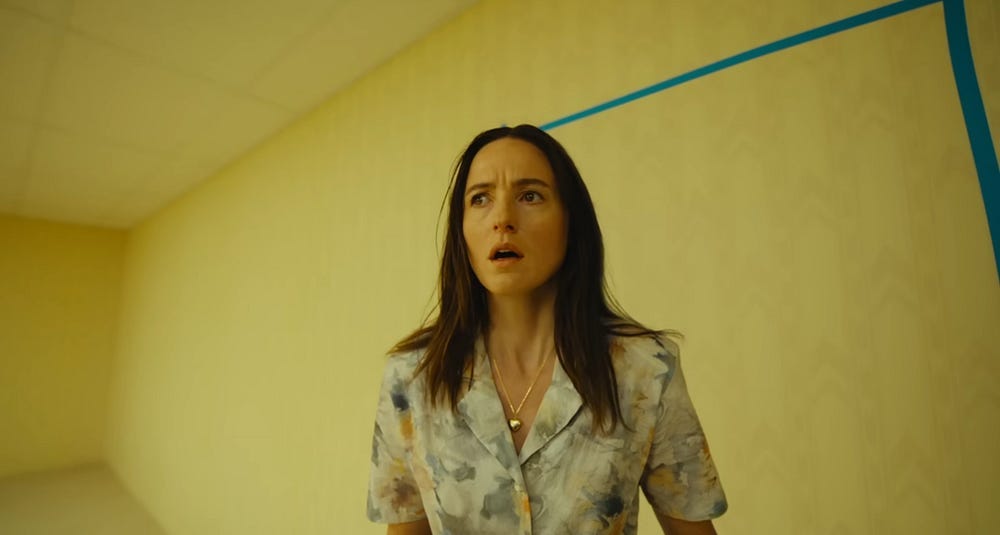
One night, Clark discovers this peculiar parallel world, or extradimensional space, or whatever it might be. At first, it looks like a yellowish open-plan office with random sticks of furniture. However, the farther he goes in, the more he discovers it is unending, with the architecture taking on peculiar shapes and sizes that recall German Expressionist art. It features portals that feel like a particularly twisted take on the tiny doors accessed in Alice in Wonderland. Or, as the film puts it, the place seems to have been constructed by someone attempting to design what they have never seen, though it has been described to them. Some bits they get right, but some bits they don’t. It’s a mishmash.
Amid this bad dream world lurks something dark and menacing. We don’t know quite what it is. Nor does Clark, but he doesn’t seem to have a problem endangering the lives of his staff, Bobby (Finne Bennett), and Kat (Lukita Maxwell), dragging them into his explorations of this extradimensional world, saying he’ll pay them overtime for this “research”. Needless to say, things go very wrong indeed.
Backrooms is a triumph of imaginative production design for Danny Vermette. The increasingly surreal spaces have a labyrinthine quality that is nothing less than extraordinary, considering the film’s comparatively small budget. Dread-inducing visuals, including furniture and later humanoid figures sunken into the floors and walls, as though they have been partially absorbed, add to the escalating psychological terror. In this respect, director Kane Parsons, who created the YouTube web series upon which this is based (in turn, an adaptation of the “Backrooms creepypasta”), is in full control. His and cinematographer Jeremy Cox’s innovative use of wide-angle lenses, gradually narrowing passageways, steep chutes, houses within rooms, and staircases across sheer drops, is seriously anxiety-inducing. And yes, at the heart of this infernal maze lies a malevolent force, the precise nature of which is genuinely unsettling.
Performances are good, with Renate Reinsve in particular offering an understated masterclass in fear mingled with traumatised curiosity (mostly on account of her experiences of a schizophrenic mother and the destruction of her childhood home, glimpsed in flashbacks). Mark Duplass also crops up in an enigmatic supporting role that I won’t spoil. I should also add that the sound design and score (by Parsons and composer Edo Van Breeman) is first-rate, with ambient noise and slow-burning, creeping unease trumping jump scares (though there are a couple of those, too, well-deployed).
For me, the greatest strength of Backrooms is its refusal to provide full explanations. There are hints, here and there, and a few reveals that provide some answers. But this is a sublimely chilling existential horror that offers nothing in the way of reassurance. What you bring to the film will doubtless reflect how you interpret it, as there are myriad metaphorical applications. For me, it has something to say about the nature of broken people who blame all their problems on someone else, perhaps due to the fracturing, misleading nature of memory. It also highlights the hypocrisy of those who fail to take their own good advice. My youngest (who saw it with me) interpreted it as a metaphor for dementia. And yes, it’s about loneliness being a bad thing. As God put it in the Book of Genesis: “It is not good that the man should be alone.”
It goes without saying that Backrooms won’t be for everyone, but once again, horror fans have another must-see to add to their list.
The Dillon Empire beyond Substack
For a full list of my published novels, click click here.
For more on my novels and other fiction projects, click here.
For my Patreon page, click here.
For my Medium page, click here.
For the Dillon on Film podcast, click here.