

A.I. Artificial Intelligence: 25 Years On
Steven Spielberg's sci-fi fable is a much-misunderstood masterpiece in urgent need of rediscovery

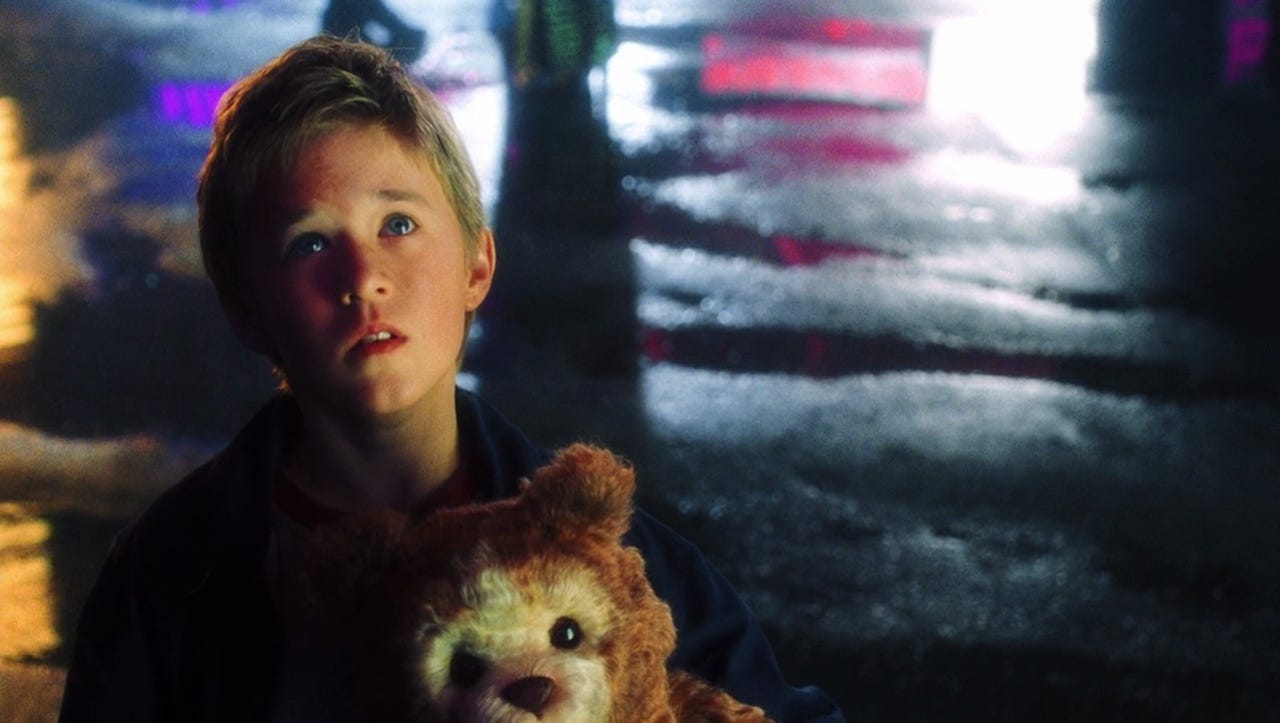
Warning: Contains spoilers
In a month featuring the release of new Steven Spielberg sci-fi film, Disclosure Day, I’m celebrating two of his earlier films in the genre. I’ve recently discussed Close Encounters of the Third Kind (1977), but now I’m turning the spotlight on another key film from the back catalogue of the world’s most commercially successful director, as it celebrates a quarter century since release: A.I. Artificial Intelligence (2001).
At the time, this was a film I eagerly anticipated. For years, I’d heard how Stanley Kubrick had wanted to adapt Brian Aldiss’s sci-fi fable Supertoys Last All Summer Long, and I’d been disappointed he’d never got around to making it prior to his death. However, upon learning Kubrick handed the project to Spielberg as he believed it was ideally attuned to his sensibilities, I was intrigued to see what the resultant vision would be, given the vastly differing styles of the respective filmmakers.
After my first viewing at the cinema, I liked the film but didn’t love it. Performances were good, and I admired several technical aspects, but for reasons I couldn’t fully understand, it failed to move me in any great way. My wife, who was in tears by the end, struggled to comprehend my muted reaction. To this day, I’m similarly bewildered as to how the film didn’t get under my skin the first time around. Perhaps I was in the wrong mood, or too immature as someone who’d yet to become a parent (or lose one) to fully grasp the mother-child dynamics explored in the film, but such attempts at explanation are perhaps clutching at straws. After all, abandonment and loss of family are key themes of many Spielberg films. In stark contrast, his also criminally underrated adaptation of Empire of the Sun (1987) left me an emotional wreck when I first saw it at the cinema at the age of twelve, so I don’t think I’m lacking in empathy when it comes to parental separation trauma.
